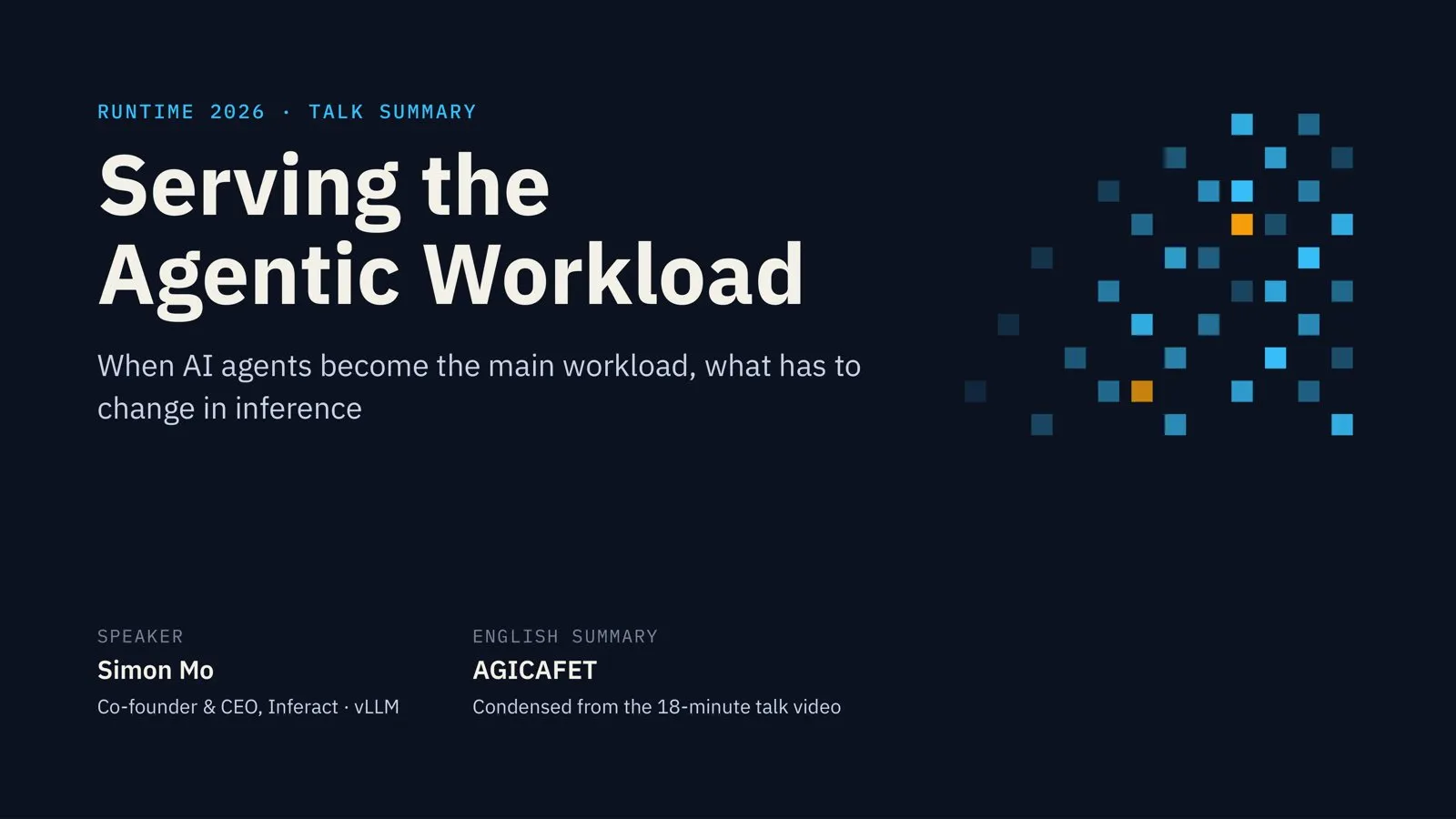
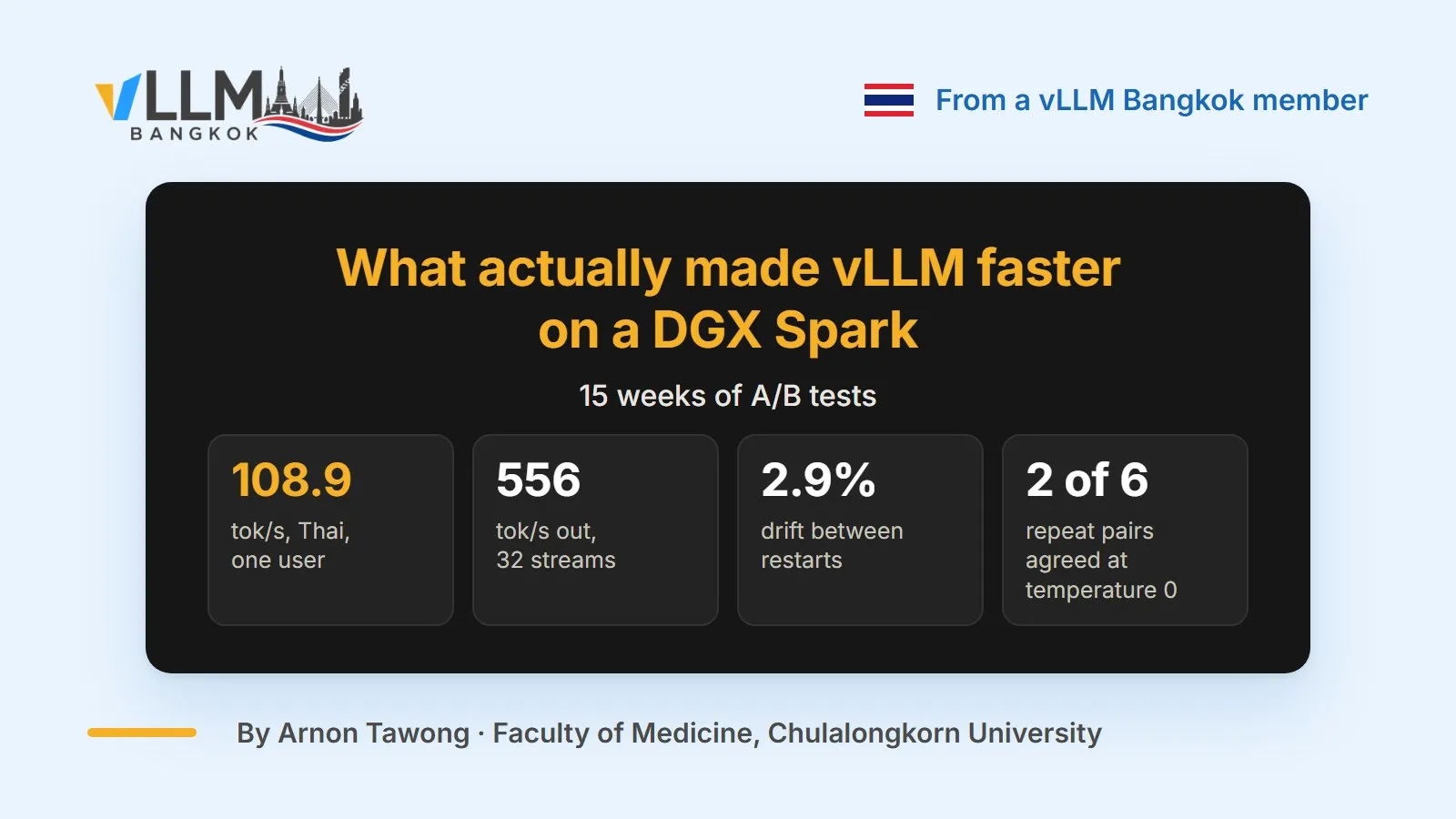
Our co-founder James at SCBX NEXT TECH: serving local models with vLLM

On Saturday 21 November 2026 our co-founder Kanin Kearpimy (James) gave the vLLM talk at the AI Developer Meetup at SCBX NEXT TECH, on the 4th floor of Siam Paragon in Bangkok. The afternoon meetup was part of SCBX NEXT TECH – TOGETHER 3rd Anniversary Chapter, a series from October to December 2026 marking three years of SCBX NEXT TECH. vLLM Bangkok was one of the meetup’s featured partners and communities, together with Thai Programmer Association, Global AI Community, Microsoft, AWS, BorntoDev, Next Flow and Spark Tech Thailand.
His talk, Serving Local Models with vLLM, was for developers weighing whether to run models themselves, and what happens inside the serving engine once they do. This post follows his slides; where we add something of our own, we say so.
His slides (29 pages):
Open PDF29 pages · 1.4 MBTL;DR
- Local or closed is a question to evaluate, not to answer once. On the cost-against-intelligence chart James showed, open models lead at the low-cost end, the two sides are on par in the middle, and closed models lead at the top.
- More GPUs are only part of the answer. A GPU at 100% with low throughput, the same system prompt that is slow on every request, whether you really need three H100s: these come down to how the engine uses the hardware.
- Four ideas inside vLLM address them: continuous batching, PagedAttention, prefix caching and quantization chosen by task.
Local or closed? A starting point to evaluate
After an opening demo, the talk turned to the question “Should we go for local model or close model?”, then struck it out and replaced it with “Starting point to evaluate this question.”
The starting point was a chart of the Artificial Analysis Intelligence Index v4.1: each model’s index score against its cost per task, on a log scale, with data extracted on 31 July 2026 according to the chart. The chart on his slide marks three zones: “open source beats close source” at the low-cost end, “open source and close source on par” in the middle, and “Close source beats open source” at the top. Where your task sits on that curve shapes the choice. (Version 4.1 was the current index from June to August 2026; Artificial Analysis has since moved to v5.0.1, with a different set of evaluations, so check the latest chart before you decide.)
Buying more GPUs is only part of the answer
Next came “Buying more GPU resolve everything?”, answered on the slide with “Partially true and we need more than hardware”, and a look behind the engineering scene: the AI (LLM) stack, layer by layer.
- API gateway in front.
- Distributed inference server: llm-d, KServe.
- Inference engine: Ollama, vLLM, SGLang, TensorRT. This is the layer the talk is about.
- Storage: Qdrant, PostgreSQL, MongoDB.
- Hardware: NVIDIA CUDA, AMD ROCm, Cerebras.
Then a slide asked: have you ever run into these situations?
- Do I really need three H100 GPUs?
- My GPU is at 100% utilization, yet my LLM service has low throughput.
- My requests share the same system prompt, yet every one of them takes a long time to process.
Why does it happen, and how do you fix it? The rest of the talk answered that.
Why vLLM
James compared four serving engines: Ollama serve (a simple local setup), SGLang (a fast serving runtime), TensorRT (NVIDIA-optimized) and vLLM, “our pick for this talk”. His reasons:
- An active community: 90,000 GitHub stars on his slide. The repository had more than 97,000 when we checked on 23 November 2026.
- Industry-grade models: the major open model families, Llama, Qwen, DeepSeek, Mistral and Gemma, all on vLLM’s list of supported models.
- A hardware range: GPU, CPU and TPU.
A short background slide set the scene: GPU memory holds the model weights and the KV cache, and the compute units run the jobs. Each of the four ideas below works on one of those parts.
Four ideas inside vLLM
1. Continuous batching: keep the GPU fed
With a fixed batch, “a batch ends only when its longest request ends. Short requests finish early and their slots stall while the GPU still has capacity.” Continuous batching refills the slot instead: “As soon as a request finishes, a waiting one takes its place. Work is fed to the GPU continuously to maximize utilization.”
The idea is also called iteration-level scheduling. It was introduced by the Orca paper (OSDI 2022) and explained well in Anyscale’s 2023 post on continuous batching; vLLM’s documentation lists “continuous batching of incoming requests” among its core features.
2. PagedAttention: the KV cache in small blocks
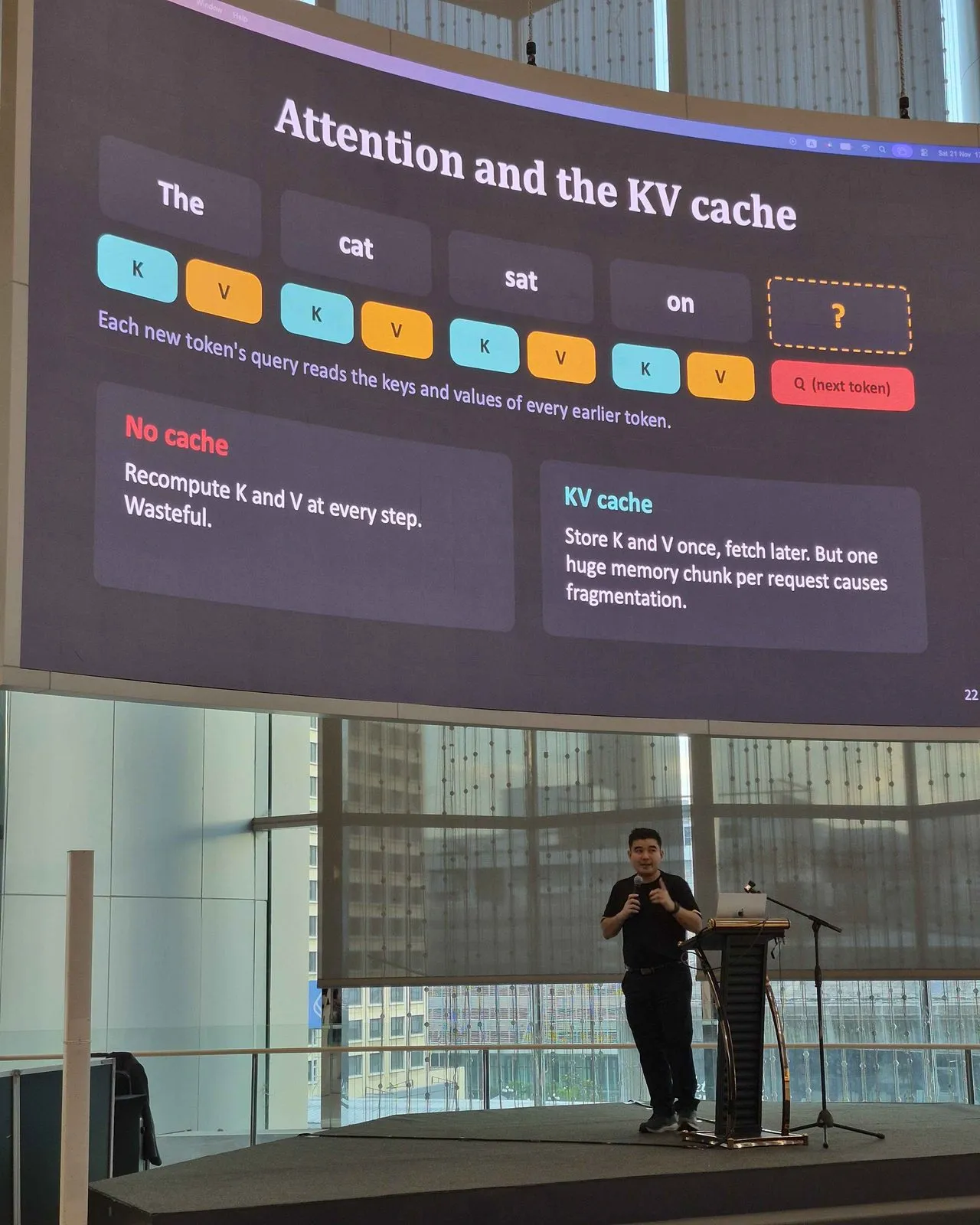
To write the next token, the model’s query reads the keys and values (K and V) of every earlier token. Recomputing them at every step is wasteful, so engines keep them in a KV cache. But storing it as “one huge memory chunk per request causes fragmentation”: memory gets reserved and sits unused.
PagedAttention borrows from operating systems. As his slides put it:
- Pre-allocate fixed-size blocks, like virtual-memory pages in an OS.
- A cache manager stores and fetches the KV blocks.
- Small blocks mean minimal memory fragmentation.
Any free block can serve any request, so more requests fit in the same GPU memory. The idea comes from the PagedAttention paper by the team that started vLLM (SOSP 2023), which reports “near-zero waste in KV cache memory” and 2-4x the throughput of FasterTransformer and Orca at the same latency.
3. Prefix caching: reuse repeated prompts
Without it, attention works request by request: two requests that both begin “Summarize this policy…” each compute their KV from scratch. With prefix caching, vLLM hashes each KV block and matches a new request’s tokens against the blocks it already has. Matching blocks are reused and only the new part is computed: “less computing, faster answers.”
vLLM’s design notes say each block’s hash covers “the tokens in the block and the tokens in the prefix before the block”, so a block is reused only when everything before it matches too. And per the feature page, it speeds up processing the prompt (the prefill), not the generation of new tokens.
4. Quantization: smaller weights, faster answers
Weights are what predict the next token. In BF16 each takes 16 bits; FP8 takes 8 and FP4 takes 4. Compressing them shrinks the model, “trading a little answer quality for size”. vLLM’s FP8 page, for example, gives “a 2x reduction in model memory requirements and up to a 1.6x improvement in throughput with minimal impact on accuracy”, and 4-bit formats such as NVFP4 and MXFP4 are supported too.
So James’s rule is to quantize by task:
- Generic chat: a quick response beats a smarter answer. Quantize to FP8 or FP4.
- Long-running agents: sensitive workflows need accuracy. No quantization, or carefully chosen; keep BF16.
One request, end to end
The last technical slide put it together. A request, “Please introduce yourself”, goes into vLLM serving Qwen2.5 on a GPU. On the diagram, prefix caching sits where the request comes in, PagedAttention and quantization sit at memory (the model weights and the KV cache), and continuous batching sits at the compute units.
Which idea answers which question (ours)
Our reading of the talk, not a slide:
- The same system prompt is slow on every request. Look at prefix caching: the shared prefix is computed once and reused. A block only matches when everything before it matches, so keep the start of the prompt identical (no timestamp or user name at the top).
- The GPU is at 100% but throughput is low. Look at continuous batching, which keeps every slot doing useful work, and PagedAttention, which leaves room for more requests in a batch.
- Do I really need three H100s? Look at quantization: halving the bits per weight (16 to 8 to 4) roughly halves the memory the weights need. PagedAttention also wastes less KV cache memory. Measure your own traffic before buying.
Next steps from the talk
- The vLLM course James pointed to: Fast & Efficient LLM Inference with vLLM, a short course by DeepLearning.AI built with Red Hat, released in June 2026.
- See James again at Siam Inference Thailand on Thursday 3 December 2026 at Cleverse, Rama 9, also live online. vLLM Bangkok is one of the hosts, and James is in the lineup with “vLLM Inference in Depth”.
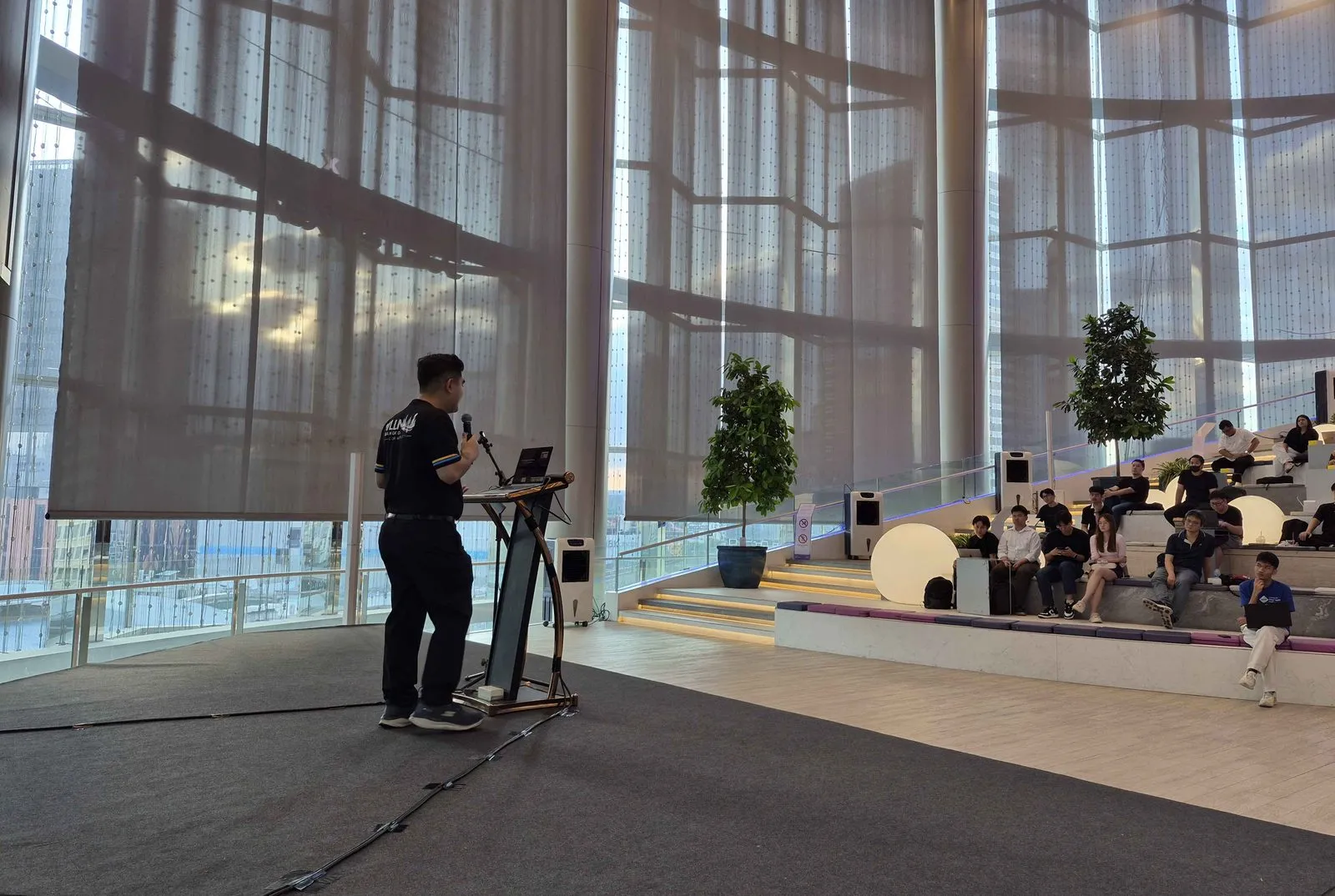
Photos from the day
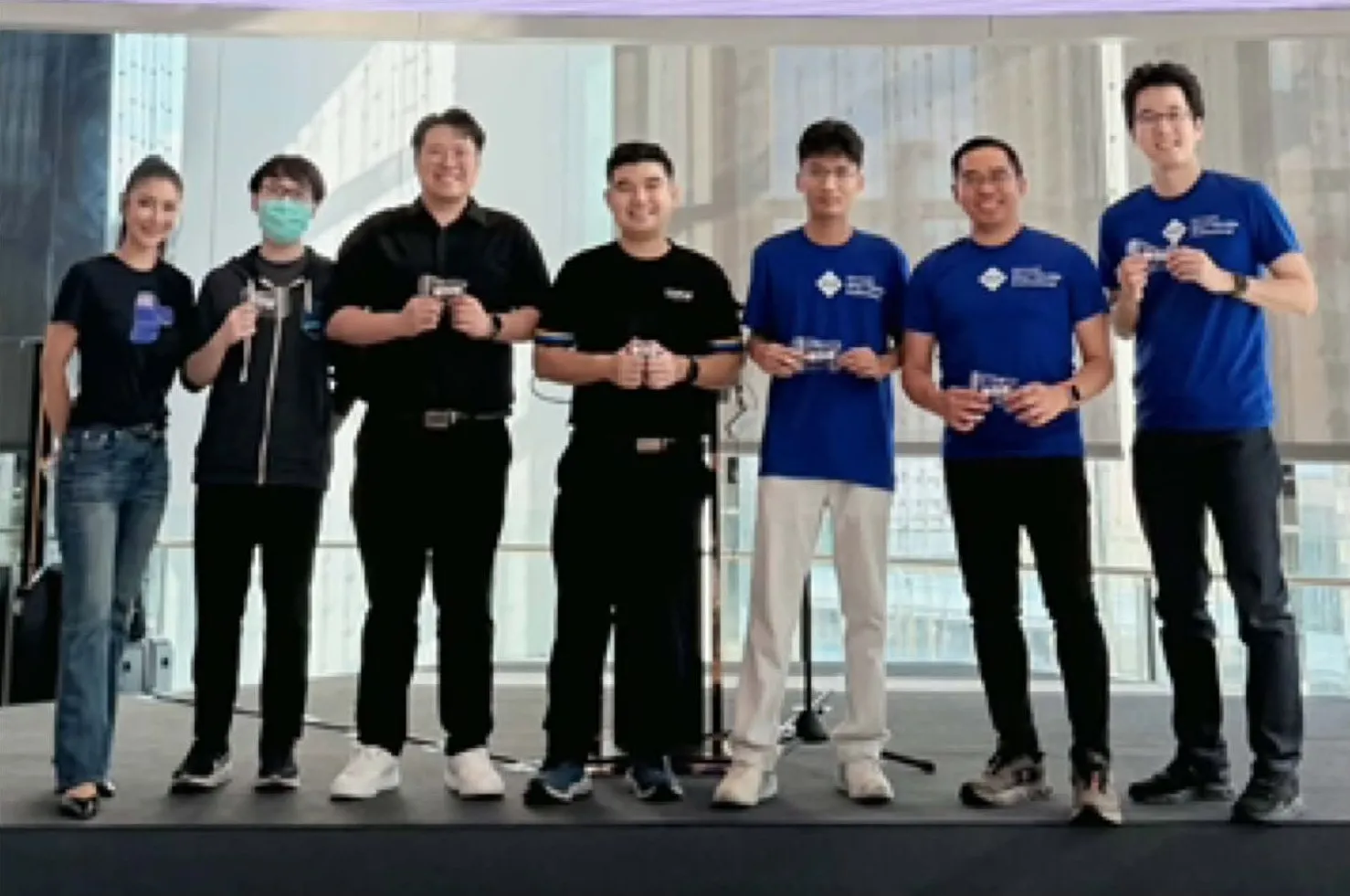

The talk and its slides are also on our events page: AI Developer Meetup at SCBX NEXT TECH.
Sources
- Serving Local Models with vLLM — Kanin Kearpimy’s slides, AI Developer Meetup at SCBX NEXT TECH, 21 November 2026. Every point and quote from the talk above.
- The poster for James’s talk (shown above). Date, time, venue and the featured partners and communities.
- ผนึก 3 คอมมูนิตี้ AI ไทย-ระดับโลก ฉลอง 3 ปี SCBX NEXT TECH ดันเทคคอมมูนิตี้สู่ศูนย์กลางการเรียนรู้แห่งอนาคต — Thai Post, 8 October 2026 (in Thai). The series SCBX NEXT TECH – TOGETHER 3rd Anniversary Chapter, October to December 2026.
- Intelligence Benchmarking — Artificial Analysis. Index version history: v4.1 from June to August 2026, v5.0.1 since November 2026.
- vllm-project/vllm — GitHub. Star count on 23 November 2026.
- Supported Models — vLLM documentation. Llama, Qwen, DeepSeek, Mistral and Gemma.
- Orca: A Distributed Serving System for Transformer-Based Generative Models — Yu et al., OSDI 2022. Iteration-level scheduling.
- How continuous batching enables 23x throughput in LLM inference while reducing p50 latency — Anyscale, 22 June 2023. Static versus continuous batching.
- vLLM documentation — “Continuous batching of incoming requests” among vLLM’s features.
- Efficient Memory Management for Large Language Model Serving with PagedAttention — Kwon et al., SOSP 2023. Paging for the KV cache, near-zero waste, 2-4x throughput.
- Automatic Prefix Caching (design) and Automatic Prefix Caching (feature) — vLLM documentation. Block hashes over the prefix; prefill only.
- FP8 W8A8 and LLM Compressor — vLLM documentation. FP8 memory and throughput; NVFP4 and MXFP4 support.
- Fast & Efficient LLM Inference with vLLM — DeepLearning.AI, built with Red Hat.
- Fast & Efficient LLM Inference with vLLM: A New Course with DeepLearning.AI — vLLM Blog, Cedric Clyburn, 3 June 2026. The course’s release.
A community post by vLLM Bangkok. The talk’s points are James’s, from his slides; our own additions are marked. Corrections are welcome via the contact on this site.