vLLM's creators now let AI agents tune the inference engine. What's in it for teams that run AI themselves?
อ่านภาษาไทย
If you have run a new model on your own servers, you may have seen one of these:
- The model just came out, but on your cards it runs slower than it should.
- Its answers are worse than when you call the same model through a provider’s API.
Inferact, the company founded by vLLM’s creators and maintainers, faces the same problem. It has just published Simon Mo’s article Building an Autonomous Inference System (November 2026) on how it deals with it. The answer is a system in which many AI agents tune the inference engine, instead of people tuning each case by hand. People still set the goals, and the performance improvements go back into vLLM.
The article opens with questions Simon says he has been asked a lot since starting Inferact: how Inferact relates to vLLM, what stays in the open-source project, and who maintains it. His short answer: Inferact builds an autonomous inference system around vLLM, vLLM stays open, and every engine optimisation the team and the system build improves vLLM for the whole community.
This post summarises the article, explains the terms along the way, checks which parts have really reached vLLM, and ends with what teams running their own models can do now.
TL;DR
- The problem: models, chips and workloads change faster than people can tune for them, so most combinations of model and chip in use have not been tuned by anyone.
- Inferact’s answer: an autonomous inference system built around vLLM. Many AI agents try changes to the engine, measure them on the whole system (end to end) and keep only the changes that are really better. People still set the goals. The full system is a long-term goal, but parts of it already run in production.
- Results in production: MiniMax M3.1 Flash’s median (p50) time to first token (TTFT) went from 1.5 s on its first endpoint to 0.8 s in production; Kimi K3’s throughput per GPU rose to about 1.8x its earlier level in about six weeks; and agents found and fixed a bug that quietly made Kimi K3.1’s answers worse on certain batches.
- Why it matters to us: Inferact says every performance improvement it finds goes back into vLLM, which is open source. One that has already reached us: MiniMax M3.1 Flash’s kernels, in vLLM v0.34.0. The autonomous system and Agent V (the agent platform Inferact’s team uses internally) are Inferact’s own, and the article does not say they will be open-sourced.
- What to do now: test each vLLM upgrade before it goes live, measure answer accuracy under real load, and before switching to a new model, run it side by side with the old one on a copy of real traffic.
Terms used in this post
- Inference engine: the software that runs a model to answer real requests (vLLM is one). It takes requests, queues them, groups them into batches and tells the GPU what to compute.
- Batch: the group of requests the engine processes together in one step, to keep the GPU busy.
- Kernel: a small program that runs on the GPU to compute one thing (such as attention). How fast a model runs depends a lot on its kernels, and the fastest kernels are usually tuned for that kind of operation and for the chip generation in use.
- Attention: the part of a model where each token looks at how much the other tokens in the context matter to it. The longer the context, the heavier this gets. Sparse attention looks at only some of the tokens.
- Context: everything the model has to read for one request, including the prompt, the conversation so far and tool results. Agents usually have very long contexts.
- MoE (Mixture of Experts): a model in which some layers are split into many smaller experts. Each token goes to only a few of them, so the model can be large without computing every weight every time.
- Workload: the kind of work coming into the system, such as short chat, long-context work or agents. Each needs different tuning.
- Throughput and latency: throughput is how much work gets done per unit of time, such as tokens per minute; latency is how long one request waits.
- Prefill and decode: the two phases of one answer. Prefill reads the whole prompt before the first token; decode then produces the answer one token at a time.
- TTFT (time to first token): the time from sending a request to getting the first token back. Most of it is prefill.
- p50 and p99: p50 is the median: half of the requests are faster than this. p99 is the value that 99% of requests are at or under, so it tells you how slow the slowest 1% get.
- Hillclimb: the article does not define it. From the context, we read it as a round in which several agents each propose a change, every change is measured, and the better ones are kept and built on, like climbing a hill one step at a time.
- Upstream: contributing a change back to the original project, here vLLM on GitHub, so everyone who uses vLLM gets it.
- Shadow traffic: sending a copy of real requests to a new system to process alongside the old one, while users still get their answers from the old one. It tests the new system on real work without affecting users.
Why people can’t keep up with the tuning
The article calls the three things that keep moving “frontiers”:
- Models: labs ship new architectures, such as a new kind of attention that has no tuned kernel yet.
- Hardware: chip vendors ship new chips that have no tuned kernels yet either.
- Workloads: user traffic shifts, from short chat to agents with long context.
Every new combination of the three needs the engine tuned again for it. Untuned, throughput is lower than it should be and the system is less reliable. The article puts the options at more than 5,000 models, more than 1,000 chip architectures and an endless range of workloads. Paired up, that is far too many combinations to try one by one.
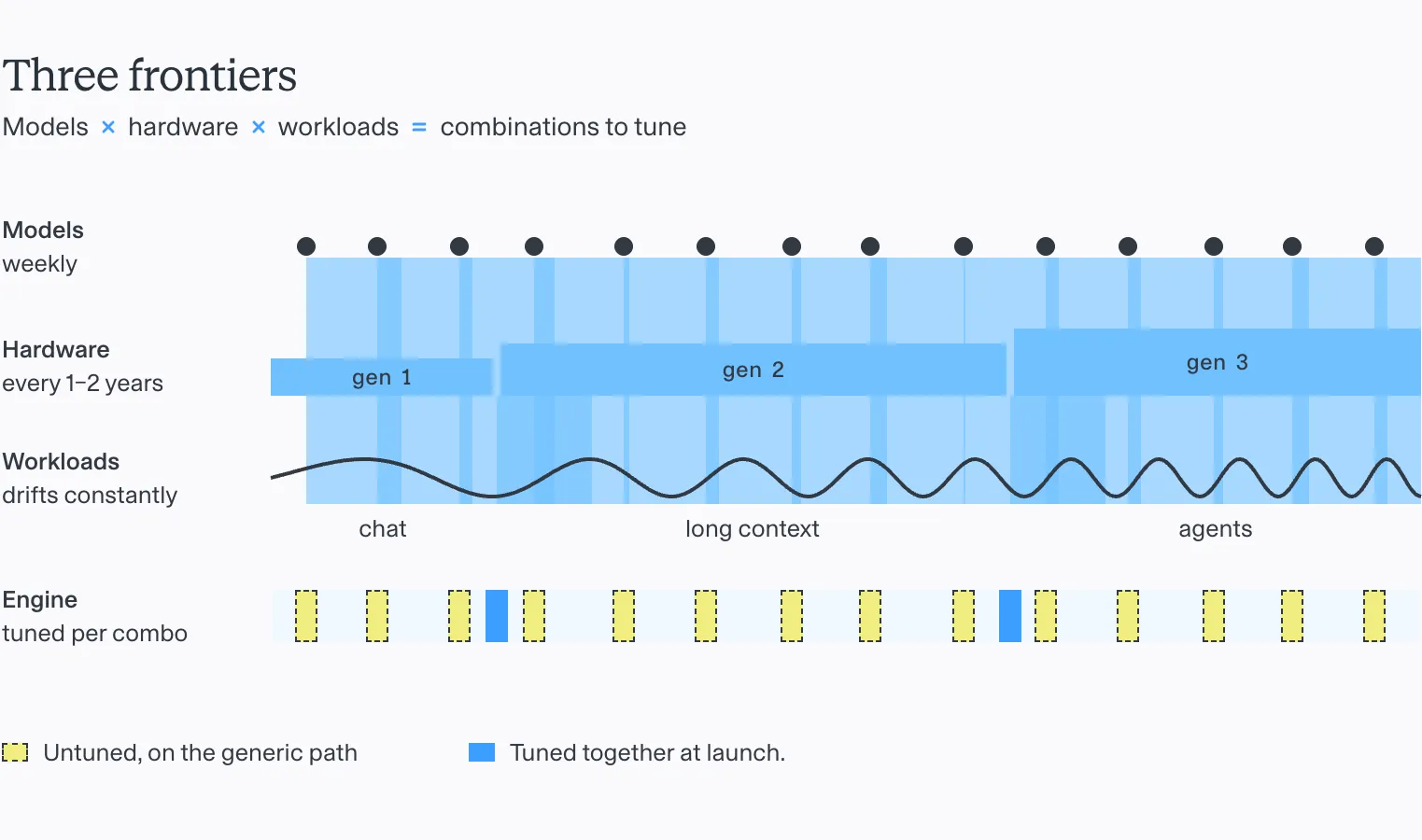
Figure from Inferact’s article: models × hardware × workloads = combinations to tune. Yellow slots are untuned, so they run on generic code (the generic path) that works but isn’t tuned for that combination. Blue slots were tuned together at launch.
Our view: this figure explains the first symptom in the opening well. A new model on the cards you use usually sits in a yellow slot: it runs, but nobody has tuned that combination yet. The second symptom, worse answers, can come from a configuration difference, or from a correctness bug like the Kimi K3.1 bug further down.
Inferact’s answer: an autonomous inference system built around vLLM
Inferact calls what it is building an autonomous inference system (AIS). In the article, autonomous means a system that takes a goal, works toward it and seeks feedback, without anyone telling it exactly what to do next. The article lists five abilities:
- Sees: it observes the production workloads it runs or is allowed to observe, and learns from what the community shares, without needing access to the community’s own deployments.
- Adapts: to new models, new hardware and customers’ changing workloads.
- Evolves: both its own code and what the article calls its “brain”: the knowledge and engineering taste it has built up behind each decision.
- Drives: it moves itself toward its goals and works through roadblocks the way a strong engineering team would.
- Optimizes: continuously, against each workload’s own targets.
The aim is for the system to keep improving “up to the hardware’s speed of light”, limited only by the compute available. The article does not define “speed of light”; we read it as the chip’s theoretical performance ceiling.
People still have a role. The article is clear that humans set the goals, decide what quality is good enough, and supply the ideas that improve the system.
What a day of this system could look like
The article gives a hypothetical example of what an ordinary day “could” look like. It is an illustration, not a record of a real event.
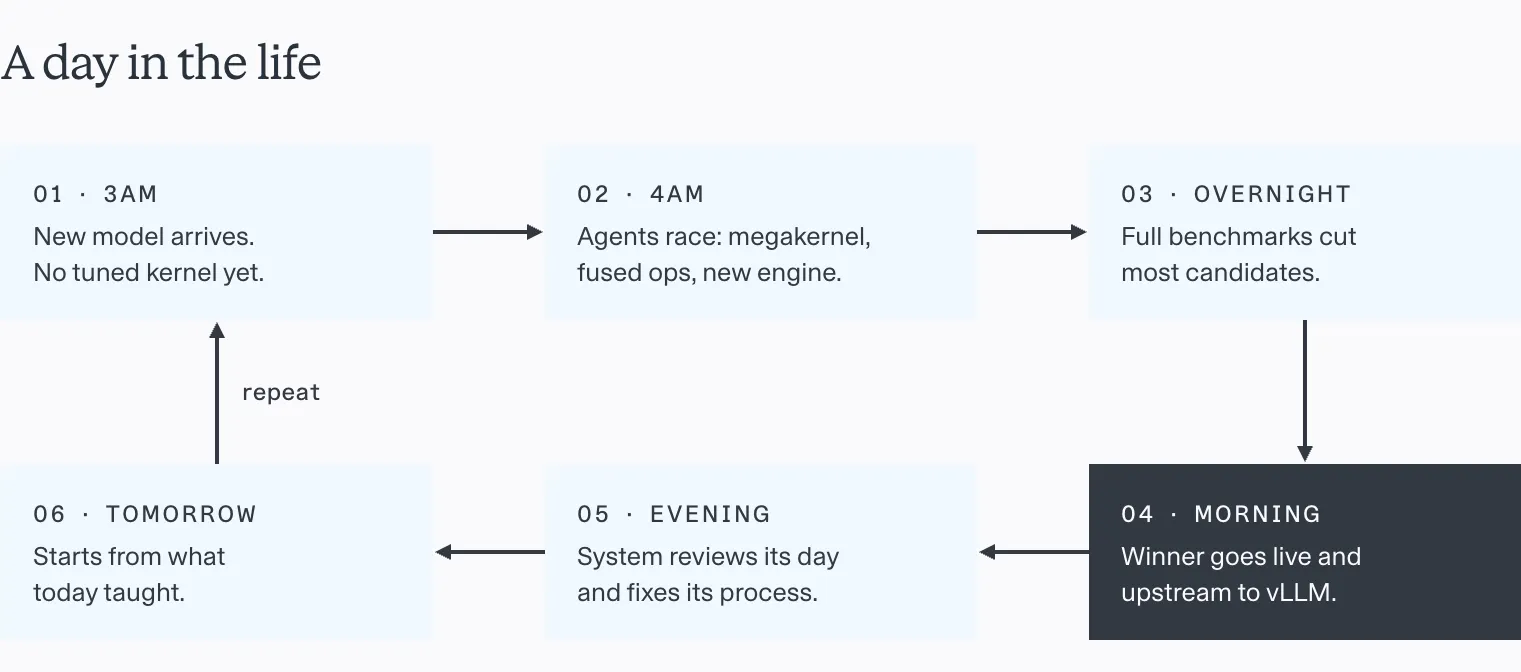
Figure from Inferact’s article: a day in the life of the system.
- 3am: a lab shares a preview of a new open-weight model. Before anyone at Inferact is awake, the system starts profiling it (measuring where the time goes). The model uses a new attention variant with no tuned kernel, so it falls back to the generic path and misses its latency target.
- 4am: unprompted, the system starts a hillclimb round. Some agents write a megakernel, one large kernel that does several steps in one go; some fuse the new operations into existing kernels; one rewrites an engine from scratch.
- Overnight: several candidates win when measured on their own but lose when the whole system is measured. Only the combination that survives full serving benchmarks moves on.
- Morning: the winning combination goes live, set up for each customer’s workload and chips, and the winning changes go upstream into vLLM.
- Evening: the system reviews its day, sees that most failed candidates died at the same check, the whole-system measurement, and changes its agents to run that check first.
- Tomorrow: it starts from what it learned today and keeps improving itself.
The point the article stresses: a speedup measured on one piece in isolation often falls short of that measurement on real traffic. So the article trusts a measured gain only once the engine has stood up to production traffic.
Already running in production
The article says parts of this loop already run in production, with two examples. All numbers in this section are Inferact’s own measurements.
MiniMax M3.1 Flash: day-0 support on NVIDIA and AMD, then tuned in production
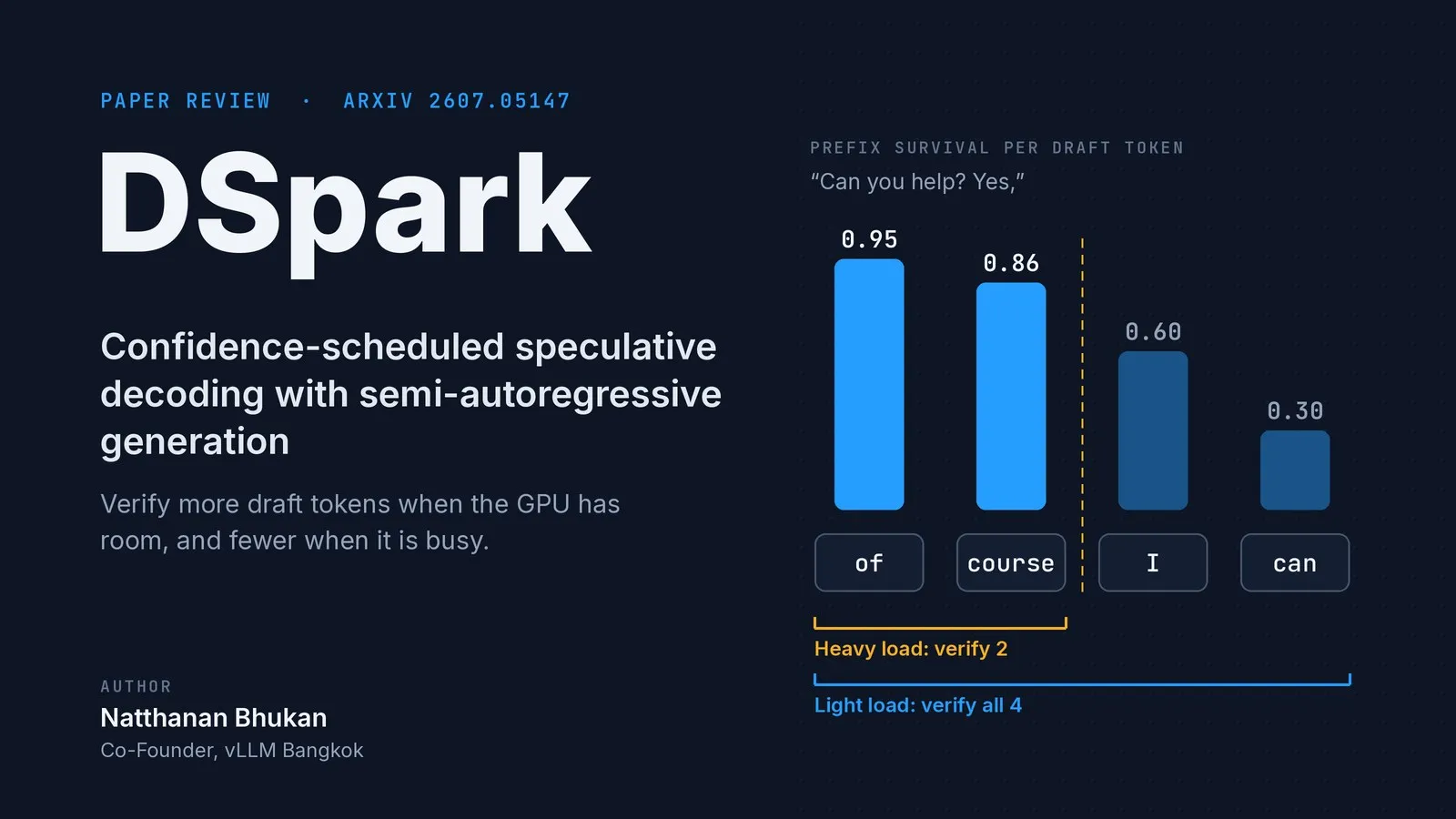
MiniMax M3.1 Flash brings several new things in one model: sparse attention with an indexer that picks which tokens attention should look at, a large MoE, image input, and built-in DSpark speculative decoding (see our DSpark paper review). The brief was for vLLM to run it on both NVIDIA and AMD, at tuned performance, from launch day (day 0).
Meanwhile the workload kept changing shape: it started as long-context coding agents, moved to traffic with short inputs and long outputs, and then became decode-heavy, because the model’s final checkpoint (the weights actually released) doubled the output length.
Inferact’s method had three steps:
- One code branch for both open-source vLLM and its production service.
- Before switching from MiniMax M3 (the previous model) to M3.1, a shadow copy of all (100%) of the live M3 traffic Inferact serves went to M3.1.
- Hillclimbing against that traffic. Each change had to pass local tests first, then evaluation on shadow traffic.
The results are below; the article says each one went into vLLM as soon as it was ready.
- Median (p50) TTFT went from 1.5 s to 0.8 s, almost twice as fast. The 1.5 s was measured on the first endpoint, which the article describes as “non-PD”; the 0.8 s was measured in production. This article does not spell out PD, but Inferact’s other article on pipeline parallelism (PP, explained below) uses P/D for running prefill and decode on separate GPUs (prefill/decode disaggregation). If PD means the same here, the deployment setup also changed between the two numbers, so the speedup does not come from kernels alone.
- Patches to the prefill code that uses expert parallelism (EP) cut TTFT by 60–70%. EP spreads the MoE’s experts across several GPUs. The article does not say what the TTFT was before.
- Pipeline-parallel (PP) prefill gave 19–46% more throughput than tensor parallel (TP). The article does not give the test conditions (PP and TP are explained below this list).
- Output per AMD card went up 56%. The article does not say compared with what.
- The missing kernels went into vLLM, including those for MSA (MiniMax Sparse Attention, the sparse attention described above), for the indexer and for NVFP4 MoE (NVFP4 is NVIDIA’s 4-bit floating-point format). Day-0 Docker images shipped for NVIDIA and AMD.
TP and PP split the work differently. TP splits every layer’s weight matrices across the GPUs, so all of them work on every token and must combine their partial results in every layer. PP splits the model’s layers into stages, one per GPU, which hand off to each other like a conveyor belt.
Another Inferact article gives two reasons why PP suits agent prefill. First, an agent can wait a few seconds for its first token anyway, because each turn spends seconds decoding and calling tools. Second, with PP the GPUs wait for each other (synchronise) only once per batch, at each stage boundary, while with TP they do so in every layer.
That article’s experiment is separate from the 19–46% above. It served MiniMax-M3.1-Flash on two B300 GPUs: under a 2 s median TTFT target, PP handled 17% more requests per GPU than TP; under a tighter 1 s target, or at light load, TP was still better. The article advises measuring other models yourself.
We checked vLLM’s GitHub and blog, and MiniMax M3.1 Flash’s kernels really have been merged and shipped in a vLLM release, with Docker images as the article says:
- vLLM v0.34.0, released on 16 November 2026 (UTC), lists MiniMax-M3.1-Flash among its new models, with Blackwell NVFP4 kernels and kernels for AMD’s ROCm, from PR #64111, merged on 29 October 2026.
- vLLM’s blog post by Inferact and the vLLM Team, 23 October 2026, gives the day-0 Docker images:
vllm/vllm-openai:minimax-m31-flashfor NVIDIA andvllm/vllm-openai-rocm:minimax-m31-flashfor AMD.
Kimi K3 and K3.1, and Agent V
Agent V is Inferact’s shared agent infrastructure. You ask it in Slack and it does the task in Inferact’s sandbox, with hillclimbing built in. Agent V itself mainly uses Kimi K3 served by vLLM: about 79% of its organic sessions (real use) and 53% of all its tokens come from Inferact’s own open-weight deployment. Inferact plans an Agent V that works with partners and the community, so we read Agent V as an internal tool for now. Inferact says it will write more about Agent V in a later article.
A bug that quietly made answers worse. When Inferact brought Kimi K3.1 up on its own serving stack, answer quality dropped on certain batches only. A 16-agent hillclimb on Agent V then reproduced the problem (made it happen again on demand) and found the cause: a switch in the attention code that chose its compute path depending on the batch’s composition, in other words on which kinds of requests happened to share a batch. The fix was then shipped, and the DeepSWE score rose from 0.558 to 0.602, matching the model’s reference accuracy.
Our view: bugs like this are nasty because testing one request at a time can miss them completely: they show up only when certain requests share a batch.
The article does not explain what DeepSWE measures, and does not say whether this fix went into vLLM. We searched vLLM’s GitHub and found no PR that matches it. But the main K3.1 splits only reached vLLM between 6 and 12 November 2026 (UTC), so the fix may already be in them. We don’t know yet.
Other Kimi numbers:
- Kimi K3.1 prefill: a 24-hour hillclimb made TTFT 2.78x faster at 800k tokens of context on GB300. The article does not give the before and after values.
- Kimi K3.1 decode: a 30-hour hillclimb cut p99 time per output token by 35%. The article gives neither the starting value nor the chip.
- Kimi K3 in production on GB300: throughput per GPU went from about 0.77 million to 1.4 million tokens per minute, roughly 1.8x, between mid-September and the end of October, through hillclimbing in production.
As for Kimi K3.1 in vLLM, the v0.34.0 release notes say the groundwork for K3.1 has landed but K3.1 cannot be served with that release. Most of the rest followed on main: the last merged split is #65685 (split 5/6), on 12 November 2026 (UTC). The sixth split, extra optimisations, is still open in #66027.
Until the next release, vLLM’s recipe for Kimi K3.1 recommends dedicated K3.1 Docker images.
Not there yet: limits and next steps
Inferact writes that AIS is a north star, a long-term goal to steer by, and that they have not got there yet. The article names three limits:
- Compute is scarce.
- It cannot simulate the world well enough yet, so it cannot test changes against traffic that has never actually happened. Agent V needs that ability before it can safely rewrite its own code.
- The feedback loop is still narrow: it comes only from deployments Inferact runs and from what customers and the community share.
The plans the article describes:
- one-click observability for vLLM, so the system sees more of the world;
- an Agent V that works with partners and the vLLM community, so the whole ecosystem feeds it;
- letting the system help run the vLLM project, such as triaging issues and testing pull requests faster;
- a system that sees workloads, adapts to models and chips, and improves itself without waiting on the Inferact team.
The article says plainly that this will be hard and that they expect to fail and learn many times over.
Why it matters to us
For anyone running vLLM themselves, we think the key sentence in the article is: “Every performance improvement we find goes upstream to vLLM.” The next line draws the boundary: “Inferact builds the autonomous system around vLLM.” The autonomous system is Inferact’s; what is promised to vLLM is the performance improvements.
vLLM is an open-source Apache 2.0 project governed by the PyTorch Foundation. The article explains that vLLM’s core engine is designed so that many different optimisations can be combined in it, so every user benefits from each release, and Simon also writes: “Inferact only wins if vLLM keeps getting better for everyone.”
The article says all this depends on a flywheel between Inferact’s production and open-source vLLM.
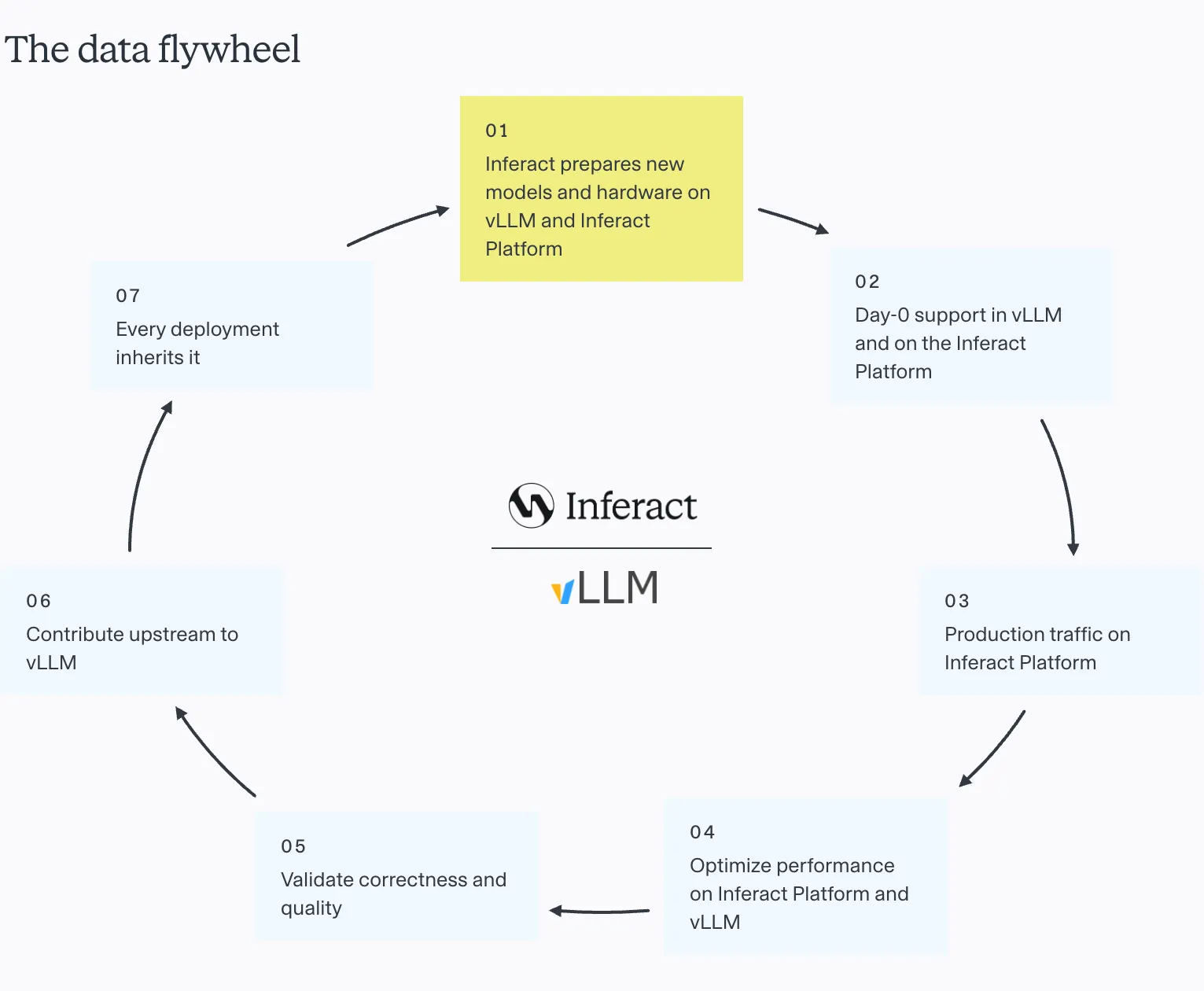
Figure from Inferact’s article: the data flywheel. Production traffic runs on the Inferact Platform (03), performance is optimised on both the Inferact Platform and vLLM (04), then contributed upstream to vLLM (06) so every deployment inherits it (07).
The rest of this section is our view.
- What reaches us: engine-level improvements that Inferact upstreams reach anyone who upgrades, such as MiniMax M3.1 Flash’s kernels in v0.34.0. But most are tuned for the model and chip combinations Inferact uses, some have to be switched on with flags as the recipe says, and deployment-level numbers such as the 0.8 s TTFT do not come with an upgrade. For an organisation that wants to run AI itself but has nobody who writes kernels, getting these kernels with an upgrade is good news: you don’t have to write them yourself. You still have to test on your own workload, as the next section describes.
- What may not reach us: the article does not say whether the autonomous system itself will be open source. Agent V is an internal tool for now, and we have not found some fixes in vLLM, such as the one for the Kimi K3.1 bug.
- What takes time: a change merged into vLLM’s main branch reaches people who install official releases only when the next release comes out. Kimi K3.1 support, for example, is so far only on main and in dedicated Docker images.
Three things to do now
Our suggestions, not from the original article.
- Upgrade vLLM deliberately. With every new release, read vLLM’s release notes, both for the models and chips you use and for the Before you upgrade section. In v0.34.0, for example, the default
--block-sizechanged from 16 to 64, and vLLM uses agpu_memory_utilizationof 1.0 when you don’t set it, which matters if you share the GPU with other processes. To try a model that just came out, look at vLLM Recipes, which collects how to run each model and its recommended starting config. Always try an upgrade on a test machine before it goes live, using steps 2 and 3. - Measure accuracy, not only speed, and measure it under real load. After changing the engine version, kernels or config, rerun the same evals (the question sets you use to measure answer quality), both one request at a time and with many requests at once, mixing short and long prompts (the Kimi K3.1 bug showed up on certain batches only). Then compare your scores with the reference accuracy the model’s makers publish. If yours are clearly lower, first check that quantization, chat template, reasoning parser and sampling settings match theirs. If the gap remains, the problem may be the engine.
- Run side by side on real traffic before switching, and measure the whole system. Before changing a model or version in production, send a copy of real traffic to the new setup (shadow), compare both latency and quality, then switch, as Inferact did when it moved from MiniMax M3 to M3.1. And don’t decide from one kernel’s benchmark, because, as the article puts it, gains measured in isolation typically fall short on production traffic.
Read the numbers with care
- All the numbers are Inferact’s, and many were measured on Inferact’s own production systems with datacenter GPUs such as GB300. Smaller setups may not see gains this large.
- Several numbers lack the before value or the test conditions:
- the 56% more output per AMD card does not say compared with what;
- the 60–70% TTFT cut and the 2.78x faster TTFT give no before and after values;
- PP’s 19–46% more throughput than TP gives no load or TTFT target;
- the 35% p99 cut gives neither the starting value nor the chip.
- The one-day timeline is hypothetical, not a real event.
Even so, we think the direction is clear: AI you run yourself keeps getting better, and at least part of that already reaches us through vLLM, as v0.34.0 shows.
Sources
- Building an Autonomous Inference System — Simon Mo, Inferact News, November 2026. The main source for the content, numbers, quotes and all three figures (© Inferact), and for the statements that Inferact was founded by vLLM’s creators and maintainers and that vLLM is an Apache 2.0 project governed by the PyTorch Foundation.
- Pipeline Parallelism for Prefill in the Agentic Era — Siyu Liu et al., Inferact News, November 2026. PP compared with TP, why PP suits agent prefill, the two-B300 experiment, and the use of P/D.
- vLLM v0.34.0 — vllm-project/vllm release notes on GitHub, 16 November 2026 (UTC). MiniMax-M3.1-Flash among the new models, the note that Kimi K3.1 cannot be served with this release, and the Before you upgrade section.
- [New Model] Add MiniMax-M3.1-Flash Model and Kernels — vllm-project/vllm on GitHub (PR #64111), merged 29 October 2026.
- vLLM Delivers Day-0 Support for MiniMax-M3.1-Flash — vLLM Blog (Inferact and the vLLM Team), 23 October 2026. The day-0 Docker images for NVIDIA and AMD, and MSA’s full name.
- [Model] Kimi K3.1 Pro (split 5/6: ROCm DCP, P/D, indexer top-k) — vllm-project/vllm on GitHub (PR #65685), merged 12 November 2026 (UTC). Split 6 is still open in #66027.
- Kimi-K3.1-Pro — vLLM Recipes, accessed 21 November 2026. The dedicated Kimi K3.1 Docker images.
Read next
- Our summary of Simon Mo’s talk “Serving the Agentic Workload”: how AI agents change model serving
- Our DSpark paper review: the speculative decoding that MiniMax M3.1 Flash has built in
All three figures belong to Inferact and come from the original article; they are used, with credit, to illustrate this summary. This post is vLLM Bangkok’s summary and opinion. If you spot a mistake, tell us through the contact details on this site.